
Market 1939 dime value today reflects both metal content and preservation state.
Production during 1939 belongs to the massive minting era of the Mercury series.
Total output across three minting facilities exceeded 100 million units.
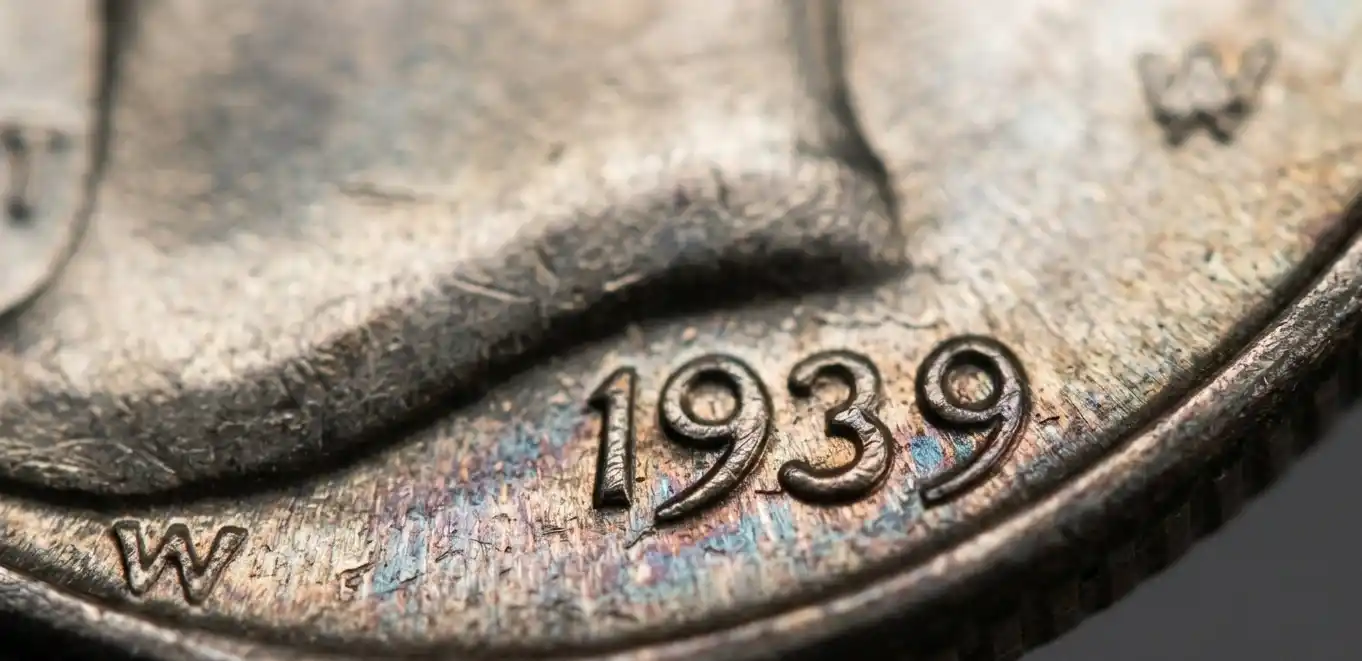
| Feature | Specification |
| Mass | 2.50 grams |
| Composition | Silver 90% and Copper 10% |
| Diameter | 17.91 mm |
| Edge | Reeded |
| Designer | Adolph Alexander Weinman |
Minting Volume Analysis by Location
Distribution of production among branches determines the current scarcity of specific items.
- Philadelphia (no mark) → 67,740,000 units
- Denver (D mark) → 24,394,000 units
- San Francisco (S mark) → 10,540,000 units
Lower production in San Francisco creates a natural price premium of 15% over Philadelphia samples.
Full Bands Status as a Primary Value Driver
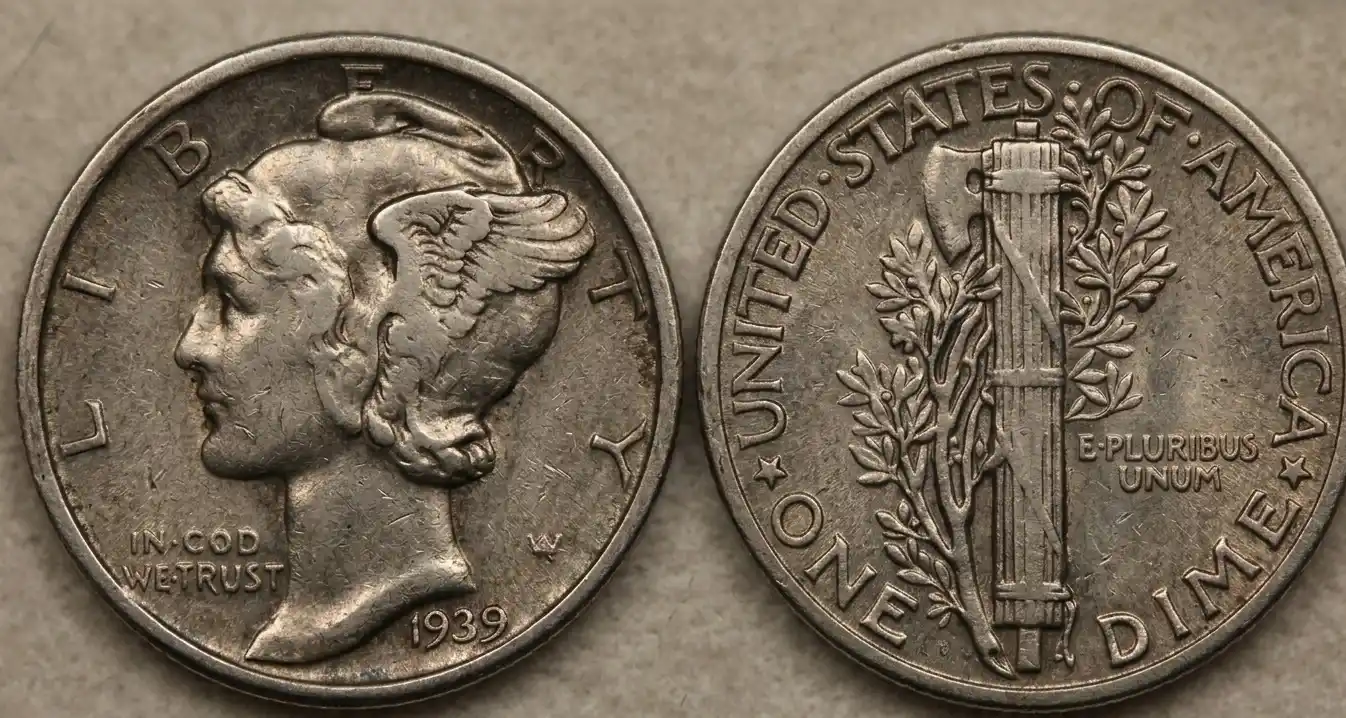
Separation of horizontal lines on the reverse fasces serves as the main indicator of strike quality.
Complete detail clarity proves maximum pressure from the minting press.
Presence of Full Bands attributes increases coin value by 2 to 5 times depending on the numeric grade.
Certification center statistics highlight the rarity of such specimens in high categories.
Price growth for coins with Full Bands on auctions reaches approximately 12% annually.
Price Trends for Philadelphia Mints (1939)
Absence of a mint mark confirms origin from the main facility.
| Grade | 2018 Year | 2022 Year | 2026 Year |
| VG-8 | $2 | $3 | $4 |
| EF-40 | $5 | $7 | $9 |
| MS-63 | $20 | $24 | $28 |
| MS-65 | $35 | $42 | $50 |
| MS-67 FB | $250 | $320 | $410 |
Low price volatility for common specimens results from their excessive market supply.
Denver Mint Specifics (1939-D)
Mark D sits at the bottom of the reverse to the left of the fasces.
Denver coins from this year frequently exhibit superior surface luster.
Correlation between planchet quality and final grade appears clearly in laboratory reports.
Logic chain of price formation:
High surface quality → Increased chance of MS-66 grade → Price rise of 25% for every half-point on the Sheldon scale.
Current pricing for MS-65 Full Bands stands at $65.
San Francisco Mint Characteristics (1939-S)
Letter S indicates production in the Western branch.
This issue features a softer strike on the central horizontal bands.
Specimens showing sharp lines from San Francisco occur 3 times less often than Philadelphia ones.
Price benchmarks for 2026:
- MS-65 → $60
- MS-66 → $85
- MS-67 FB → $750
Auction record for a 1939-S in MS-68 Full Bands condition reached $11,163.
Wear Factors and Preservation Categories
Long-term circulation leads to the flattening of raised relief parts.
Expert evaluation and the best coin identifier app rely on analyzing specific wear points.
- Hair above the ear of Liberty → first area losing detail.
- Feathers on wings → smoothing of texture during prolonged contact.
- Central bands of fasces → key element for MS grading.
- Coin rim → appearance of nicks and scratches.
Weight loss of 0.10 grams due to wear reduces the coin category to Good.
Minting Errors and Rare Varieties
Technical failures during the production process create unique objects for collection.
- Double die strike → doubling of date elements or letters.
- Centering failure → shifting of the image relative to the rim.
- Die crack → appearance of a raised line on the coin field.
Discovery of a significant shift (over 10%) raises the value of a common coin to $100 or more.
Survival Statistics of the Mintage
Large portions of 1939 coins underwent melting during periods of high Silver prices.
Experts estimate survival at no more than 15% of the original volume.
Less than 2% of the mintage remains available in high collector quality (MS-65+).
Demand and supply ratio in 2026:
Demand for MS-67 → 100 requests / Supply → 5 lots per month.
Supply shortages in the upper price segment trigger aggressive bidding at auctions.
Comparison with Adjacent Years
Contextual analysis allows understanding the 1939 year’s rank in the series hierarchy.
Mintage of 1938 was significantly lower, making it more expensive.
Issue of 1940 is comparable in volume and price characteristics.
Percentage difference in value (1939 vs 1938) in MS-65 grade:
1938-D ($80) / 1939-D ($65) → premium for the 1938 year equals 23%.
Evaluation Methodology in the Open Market
Sales through internet platforms require high-resolution detailed photographs.
Buyers in 2026 prioritize video reviews of the listed items.
Key verification steps before purchase:
- Certificate serial number check in the online database.
- Inspection for signs of tampering on the plastic holder.
- Analysis of sales history for similar specimens over the last 6 months.
Average time for selling a liquid coin takes 14 days.
Role of Professional Certification
Third-party grading services became a mandatory standard for deals exceeding $100.
Companies and the Coin ID Scanner perform metal testing to identify fakes.
Application of X-ray methods confirms the 90% Silver content.
Probability of encountering a fake 1939 coin remains extremely low due to its availability.
Forgeries appear more frequently among rare dates such as 1916-D.
Storage and Logistics Protocols
Transportation of valuable specimens happens via courier services with insurance.
Insurance cost constitutes about 1% of the declared value of the lot.
Internal safe construction must provide a constant moisture level.
Moisture increase to 60% triggers the appearance of dark spots on the edge.
Environmental control guarantees the preservation of the grade for decades.